

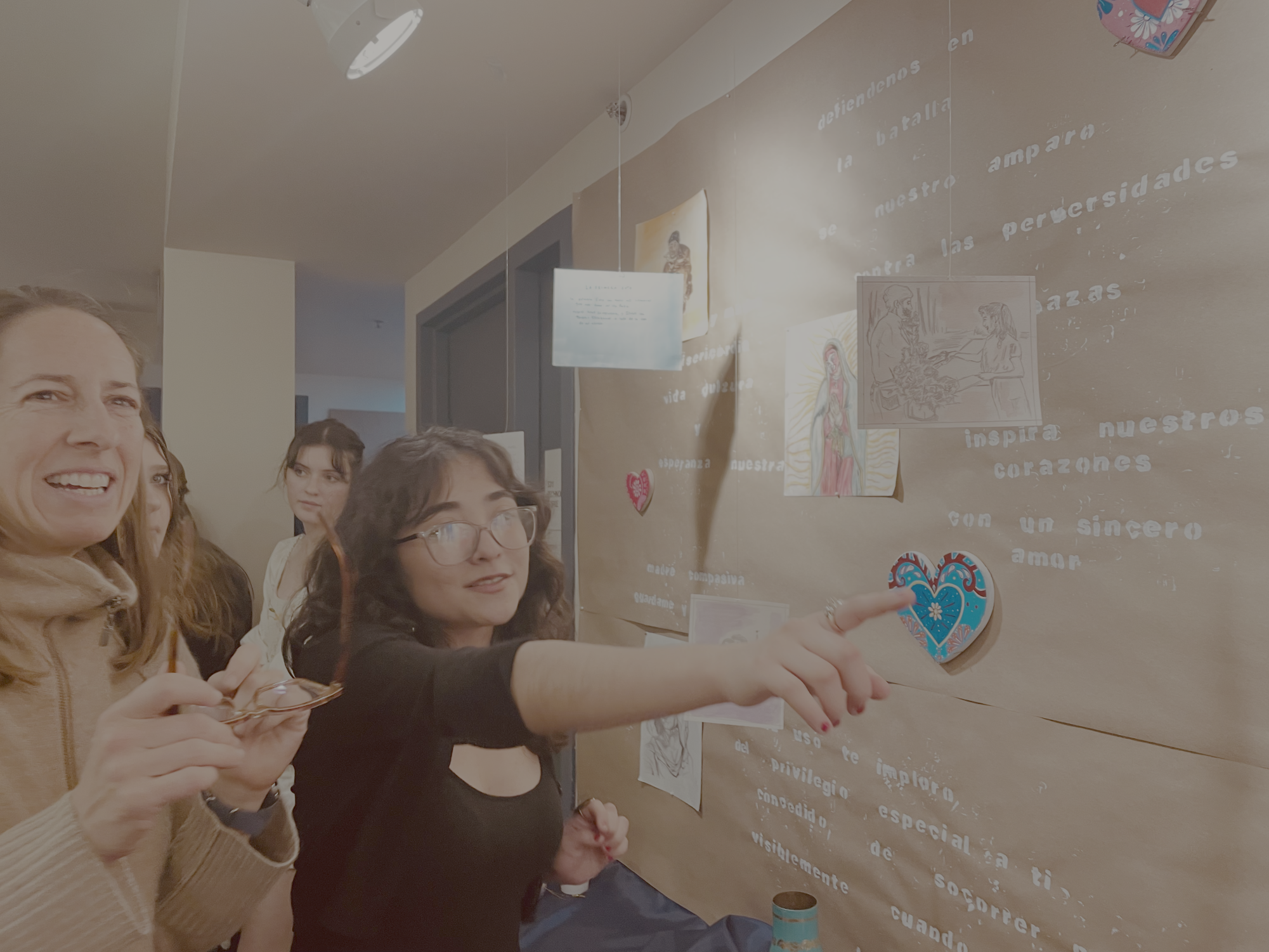
On Feb. 19, 18 seniors presented their art at the 22nd annual Winter Art Show. The artists worked for 10 weeks in the Advanced Art Exhibition class to create their pieces. Their projects — ranging from short films and sculptures to crocheted roses and large paintings — remained displayed around the school for nearly three weeks.
“We’re going to have as good — if not better — of an art show than last year. We have sculpture, painting, painting incorporated with other things as well photography. … It’s a real variety,” Advanced Art Exhibition teacher Karen Rose said.
Students can apply to the Advanced Art Exhibition class in their junior year. Applicants must submit a developed idea for a potential project for the class as well as a portfolio and a written application. Because the class size caps at 18, a group of visual art teachers and staff work to narrow the applicant pool based on students’ previous artwork and visual art class expertise.
“In the Winter Art Show, there’s usually a mix of the people who are known as ‘the artists’ and a mix of some people who are definitely artistic, but you don’t get to see their work as much,” Audrey Thornton ’26 said. “Our grade is pretty talented and we don’t always get to see it. … I’m just always impressed.”
Theo DiLullo ’26, who created a seven-foot-tall human head using various materials, began working on his Winter Art Show project in the fall and continued through the winter. “I’ve taken sculpture three times and done a clay head project twice,” he said. “I’m pretty familiar with making heads and faces, so I’d imagine that was a reason why I chose [to make] the giant head.”
Sara Xa-Chin ’26 created a miniature artistic rendering of a building that she imagined while writing a science fiction novel. “My project is meant to be seen from a 360-view,” she said. “[Viewers are] meant to walk around the whole building and look at the little details: the papers, the things scattered across the floor, the floorboards that are individually put together. And I would love people to take time to try to figure out what it means.”
The community has helped support student artists throughout their creative processes. “When I’m working on [my project], a lot of members of the Urban community come up and say, ‘Oh, wow, this looks so cool,’” DiLullo said. “It’s a really supportive environment.”
Advanced Art Exhibition students gave suggestions to one another throughout the term to help one another develop their ideas and improve their pieces. “Being in a space full of artists … is the best thing I could ask for for my creativity,” Xa-Chin said. “There [was] no comparing of each other’s projects, no competition at all. Just support [and] helping one another in our own mediums and style.”
Some incorporated aspects of their youth into their work. “Oftentimes, I have seen color depict my mood, my life, the personalities of people around me, but most prominently: childhood. I remember colors representing freedom, playfulness, and imagination. For this project, I wanted to represent this imaginative childhood feeling,” Winter Art Show student Frannie Oakes ’26 wrote in her artist statement. “Creating abstract drawings, I then projected them onto my sister, prompting her to simply play with the shapes and colors.”
Many students took on unconventional formats for their pieces. Mason Hoyt ’26 collected bacterial samples to form a petri dish map of 27 locations in San Francisco that are meaningful to him. Stella Monberg ’26 crocheted oversized roses by hand in a multicolored array. Jaqueline Villegas ’26 created a Latinx- and Chicanx-inspired combination of paintings and other pieces, using her art to explore past generations and experiences.
“My pieces explore the intersection of faith, immigration, and family through paintings, drawings, and an altar-like installation. I created this piece to honor my parents’ journey as immigrants and to question how religion, gratitude, and survival become intertwined in communities shaped by displacement and struggle,” Villegas wrote in her artist statement.
Ultimately, artists chose to create pieces that spoke to their lives and interests. “I hope that people think interesting things and come up with ideas if they are inspired [by my piece], but they don’t have to be,” Hoyt said. “I did this to share a thing that I love, that they don’t have to love.”