


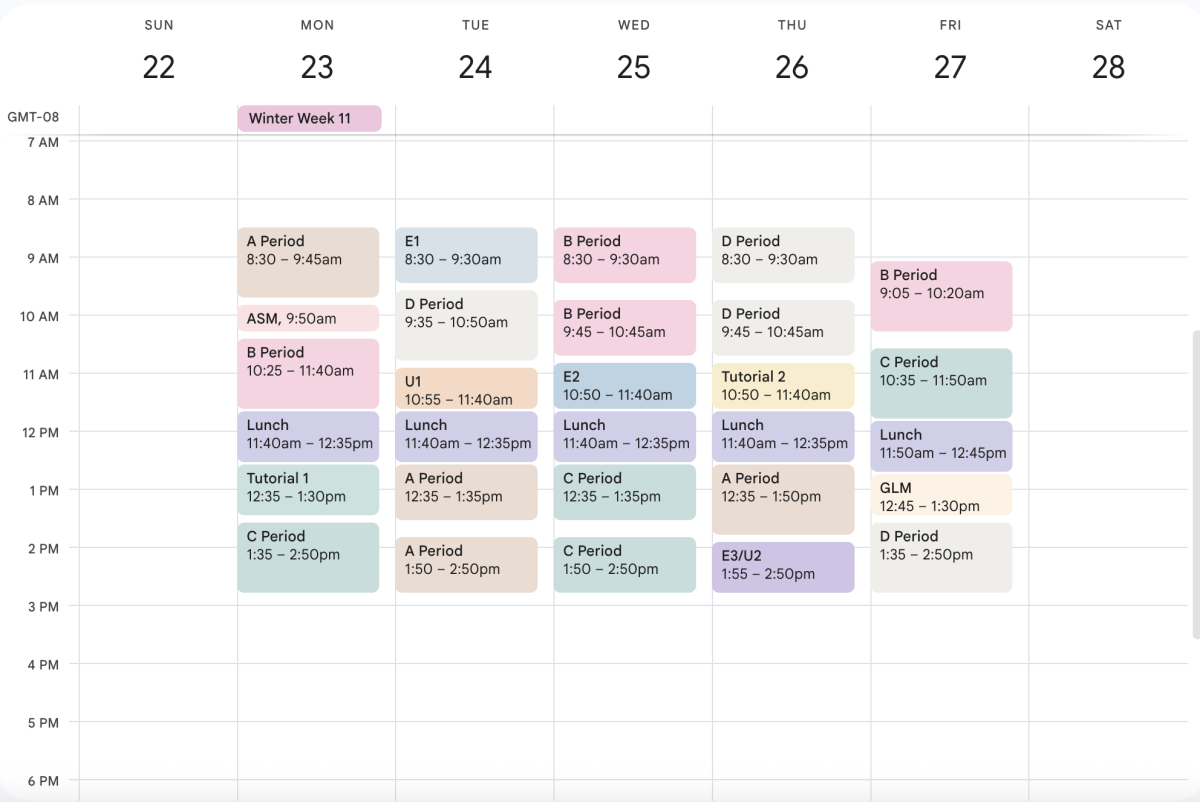
Urban students rarely have a day with four classes, let alone the seven or eight common at more traditional high schools. The Urban schedule is unique among San Francisco high school schedules, with no other school mirroring its combination of trimesters, four-class terms and block schedule.
Urban functions on a trimester system, which divides the school year into three parts. Students take four classes each trimester and are required to take at least two trimesters of each core subject (math, science, English, history and language) during each of their underclassman years. As upperclassmen, students are able to choose all of their classes, though their course selection must include two trimesters of English and one service learning class each year.
In a typical five-day week, students have two single (75-minute) periods and one double (120-minute) period for each class. Oftentimes, teachers structure their curriculum to introduce a subject during the first single block, lead a longer activity during the double block, and a reflection or assessment of the new material during the second single block.
Each aspect of the Urban schedule is carefully designed by the administration. “I’m always thinking about how [we] can organize school and organize the school day in a way that really leverages our mission and our core values and … provide[s] opportunities for students and teachers to work together,” said Giselle Chow, assistant head for teaching and learning. Urban’s core values and mission statement say the school aims to help students become more passionate about learning both at and beyond Urban.
“Double periods, for instance, [are] what makes labs possible in science. It’s what makes service learning possible during the school day [and] field trips across all the classes. … Those things support the mission [and] core values of the school,” Chow said.
Longer class periods aim to allow students to engage deeply with the material. “In English and history, … being able to have longer discussions with other classmates has made me more interested in certain subjects. I’ve appreciated when we get to spend a really long time just talking with each other openly about certain readings. That wouldn’t be able to happen [in a] 75-minute period,” said Katie Carroll ’27, Program Innovation Committee (PIC) student representative. PIC is a group of students and faculty who discuss and make decisions about the schedule and curriculum.
Carroll believes double periods can have positive effects extending beyond the classroom. “I think it’s important to have double periods in classes, even if they feel difficult at first, [because] building up [your] focus is really important,” she said. “It’s so easy for our attention span to deteriorate, … [so] I think it’s an important skill to build.”
The current schedule was designed by the Urban administration in 2016, with former Academic Dean Geoff Ruth and English teacher Jonathan Howland leading the process. Over the next five years, Urban has set a strategic plan to reevaluate the current schedule and how it functions, especially in the context of the school’s core values. Alongside PIC, Chow has been involved in the early stages of planning this schedule change.
“I see myself as in charge of a process by which the community decides what’s most important to them in the schedule. When I say community, I mean … not just the teachers, the students, grade deans [or] department chairs — everybody will have a say in this process,” she said.
One aspect of the Urban schedule that strongly affects both teachers and students is the trimester system. Because most students only take each core class during two out of the three trimesters — meaning, for example, students have just two terms of math each year — teachers must think through how they can condense their classes into only two-thirds of the school year. While Urban has longer class periods than many other schools, the total amount of time spent in each core class per trimester is less than how much time other San Francisco high schools spend in each of their core classes in one semester.
“We are doing more with less time. We have [a] year-long curriculum that we are putting in two-thirds of the year. … The schedule demands that we actually choose what we think is critically important for a particular course,” Chow said. “In some ways, you could say [this] is a good thing, because then you know everything you do in a class … should feel like it’s really important. There’s no … fluff, or filler. Everything is there for a reason.”
Students take just four core classes per trimester, with the intention being that with fewer classes, students can more deeply engage with each of them. In a typical five-day week, students have either two or three core classes each day. “I remember in middle school, there would be days where I’d have six classes in one day. The amount of focus I was able to give to each class … was deteriorating … throughout the day,” Carroll said. “It just made academics unenjoyable, so I appreciate only having to do three classes a day. I feel like I can really bring my full self to all my classes.”
Kaliopi Terplan ’27 attends Lowell High School, a large San Francisco public school in Lakeshore. Lowell runs on a schedule with up to eight periods a day, where students are required to enroll in at least six classes in their ninth through 11th grades and at least five classes as a 12th grader.
Two days a week, Lowell functions on a block schedule similar to Urban’s, with longer class periods. “I really struggle with sitting in an hour-and-a-half-long class,” Terplan said. “Sometimes during a block day, … you can see the teachers are losing steam and the students are losing steam. People start [getting] restless and unproductive.”
Other public San Francisco high schools, including Ruth Asawa School of The Arts (SOTA), operate on a block schedule. Students have between four and five core classes each semester. Each class meets for 75 minutes three times a week. Like many other San Francisco high schools, SOTA does not allow students to choose their own classes during their freshman year. However, students are admitted to SOTA based on an arts concentration, which corresponds to two of their class periods per day.
“I feel like there’s way too much structure. You don’t really get to choose your elective freshman year, you’re just given certain classes,” SOTA student Ovia Sarangan ’29 said. “There are two [science] pathways — the biology pathway and the physics pathway — but you don’t get to make that choice until sophomore year.”
Despite this aspect of the overall schedule, the weekly schedule gives students more freedom. The schedule sometimes gives students one day in between class periods. “The schedule makes it a lot easier to handle the workload,” Sarangan said. “[Because you] don’t have each class [every] day, you can get all your more urgent homework done for the classes you have the next day.”
Lick-Wilmerding High School is another private high school in San Francisco. The school functions on a block schedule, with students taking eight classes at a time in ninth grade and six or seven in 10th through 12th grades. Their schedule has four 70-minute classes a day, along with 40 minutes of Tutorial or Community Time. Students are able to use their Tutorial or Community Time to speak with teachers, study, hang out with friends or simply to take a break from their academics.
Similarly to Urban, Lick-Wilmerding’s schedule shifts the order of classes each day, meaning each day in a week looks different from the day before. “I enjoy the rotating aspect of the schedule because I don’t have the same class first each day,” Lick-Wilmerding student Elsa Wallin ’28 said. “There [are] certain times of day where you don’t really want to be taking a certain class, like after lunch. Everyone [is] so tired and it could affect your feelings or performance in the class.”
Oftentimes, students balance their schoolwork with extracurricular activities and socializing. Urban’s school day begins at 8:30 a.m. and ends at 2:50 p.m. “I enjoy that we get out of school earlier. … When I was in middle school, I didn’t get out till 4 p.m. and … I wasn’t getting home until 5 p.m. I barely had a social life,” Carroll said. “So, I appreciate that school only feels like a certain fraction of my day, and I can spend the rest doing homework or whatever else I want to do. … I have time to get to extracurriculars. I have time to build a social life.”
Other schools, including Lowell, have longer school days, which leaves less time for students to involve themselves in extracurriculars unrelated to the school. “There [are] lots of people that are in sports or things that meet after school every day, [like] clubs, and just come to practice later. But [the schedule is] definitely something that limits your involvement,” Terplan said.
Many high schools around San Francisco — including Lick-Wilmerding, Lowell and SOTA — build in an open block, often called an off block, for their students, which often functions as a study hall, a time to take a break from academics, or an opportunity to sleep in or return home early. At Lowell, the off block is rotating, meaning at least one of a student’s eight blocks is a study hall. So, a student with an A period off block can use that time as a study hall. “Managing [schoolwork] has come down to doing a lot during my off block. … I think I would die this year if I didn’t [have it],” Terplan said.
At Urban, these types of breaks are at the same time for all students with varying amounts of freedom as students get older. Students have a set number of E, U and T periods. During E periods, students either have study halls or participate in elective classes such as a music ensemble or yearbook. T periods function as office hours where students can meet with teachers. U periods are ungraded electives such as UrbanX: Design, Balloon Twisting and The Beat Without: Writings from Incarceration.
At other schools, like Lick-Wilmerding, students attend their electives during a regular block, as though they were regular classes. “I enjoy that we have 70 minutes for each period. … In some other school’s schedule, [students] might get less time, but because we just have the same amount of everything, I get to enjoy more time doing the more fun classes,” Wallin said.
Over the next two years, Urban will work to develop a new schedule that accounts for the ever-changing wants and needs of the community.
When administrators look to reevaluate the schedule, many people will come together to consider aspects of students’ and teachers’ lives. “I would really love people to come to those conversations with questions,” Chow said. “I would like us to think more broadly and creatively first, because if any school can think that way, I think it’s our school. I just hope that we can be loose and feel free enough to do that.”