


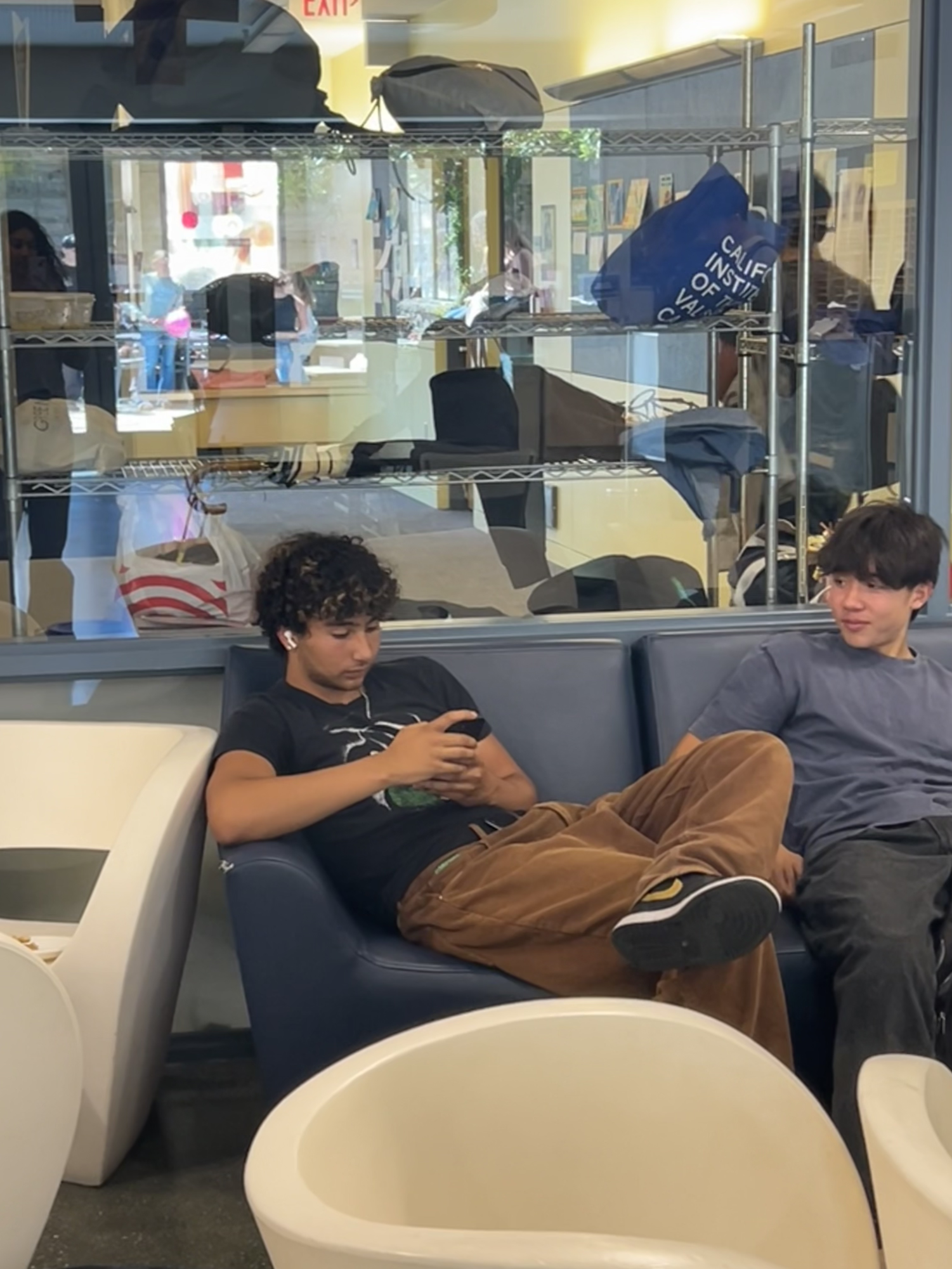
Every moment we spend glued to our phones on school premises is a moment we could have spent forming real connections with classmates or pursuing individual creativity. Our brains are melting into our screens, one glance at a time. Think about it: how often do you reach for your phone during the school day? Do you look while you’re walking in the hallway? What about during class? Or zoning out in a 15-minute break? Turning to phones as a safety blanket or to pass the time on school premises is a habit that has become far too normalized. It is time we hold ourselves accountable for this habit and take real steps to reclaim our focus and connection with others.
A University of Michigan Medicine study of 203 teens between the ages of 11 and 17 found that students receive about 240 notifications every day, 60 of which are during school hours.
Ignoring one ping may seem simple, but a constant feed of inputs throughout the day can feel impossible to ignore, naturally increasing phone usage. “When you’re on your phone, it adds to stress,” Olivia Prime ’27 said. “It brings in the media and people outside of school, add[ing] pressure and more stuff to think about during the school day, making it harder for us to connect.”
Students can prioritize phone use over real-world activities, like connecting with family or being outside. “If one of my parents asks me if I want to go on a walk, it’s not like I don’t want to do that, but in almost every scenario, just being on my phone requires much less effort,” August Chen ’27 said.
Staring at a screen can allow students to avoid awkward or uncomfortable moments, which are crucial in building social bonds and resilience. “There’s a perception [that] if you’re on your phone or your computer while you’re eating [alone], you’re not a weirdo,” Griffin Hayward ’25 said. “It’s kind of like a protection.”
My own phone offers a quick escape from boredom. However, when I turn to a screen every time I want stimulation, I miss out on opportunities to engage in more intellectually enriching activities, both inside and outside of school. “Trying and learning new skills is something students have an aversion to as they get older, because it’s so easy to extract some enjoyment from just interacting on Instagram,” Hayward said.
Screen time is not always allowed at Urban — phones are prohibited during school-sanctioned trips, for example. Students notice a stark difference in their social experiences when they are without their devices. “Usually when I’m uncomfortable, I go on my phone to take away that feeling [by acting] like I am doing something. But at the Pinnacles trip, I was actually forced to go talk to someone new,” Prime said.
To simulate her experience at Pinnacles, Prime went phoneless for a school day at Urban. “I feel like I created more genuine connections,” she said.
Going phone-free during the day will prevent interruptions in your interactions with others and exploration of other interests. By reducing usage at Urban, we can build stronger connections and relieve stress.
Technology is becoming more advanced and accessible, so now the power lies in your hands. You can take responsibility for reducing your screen time, starting with one small, tangible step: Keep your phone in your bag or leave it in a classroom during lunch and breaks. Find a time to use your phone that works for you, but that doesn’t interrupt your socialization or exploration of your interests.
Go phone-free for a day and turn the little glowing object we have learned to rely on into a less significant aspect of your life. Hit silent mode and give it a try.