


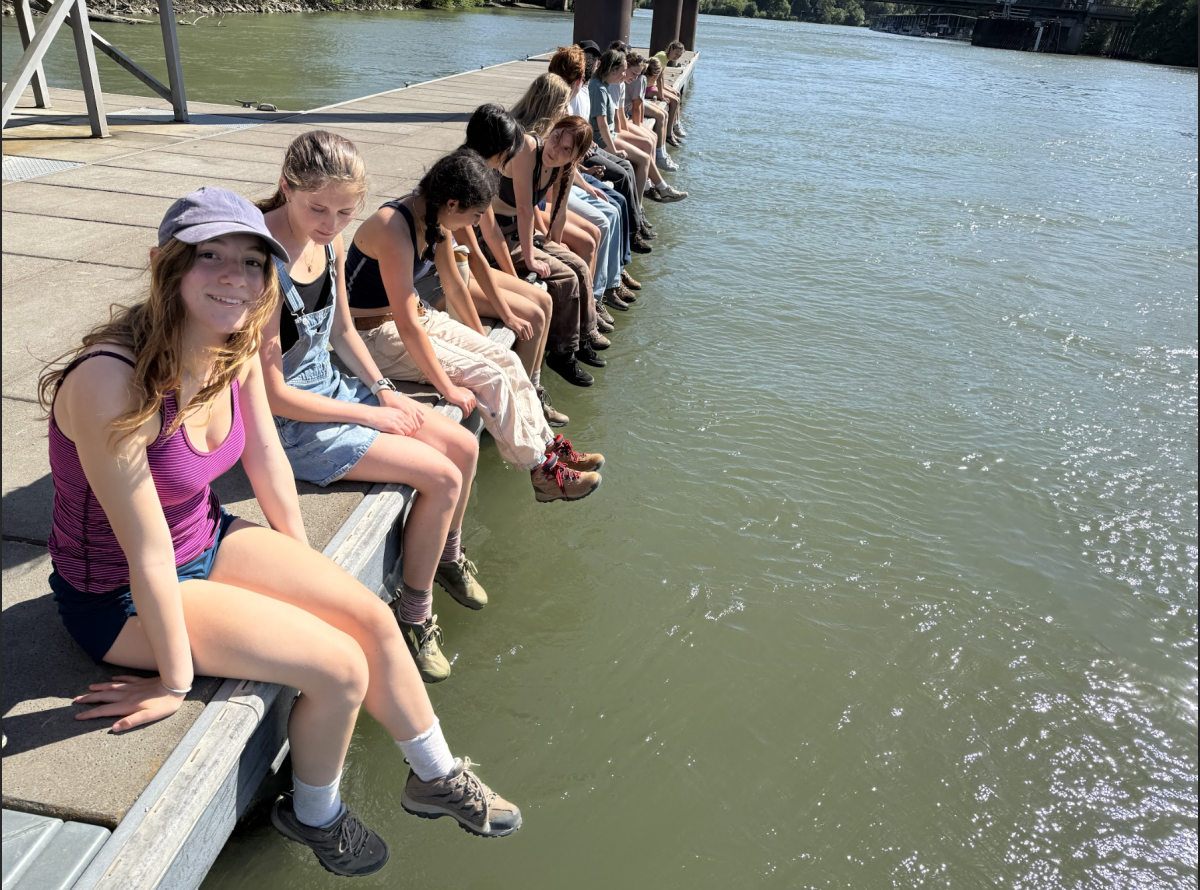
Small efforts — composting, learning about ocean acidification in Science 2B, attending Green Team’s clothing swap or going on a hike during Class Days, for example — can make the often daunting environmentalism movement more approachable. Schools can play a vital part in combating the climate crisis by educating students on the environment and their potential roles in protecting it.
Urban takes many efforts to be environmentally conscious. In 2018, Urban switched all of its lighting to LED bulbs, which, according to the U.S. Department of Energy, are at least 75% more energy efficient than traditional incandescent bulbs.
The school’s choice of lighting is just one of several efforts to be “green,” or environmentally-friendly. “All our chemicals are green. [Our] trash bags are green. All our utensils that we use for food are green,” said Dave Coffman, facilities manager, about Urban’s compostable products. “We’ve always been working towards trying to be as sustainable … as we possibly can with everything that we do here.”
In addition to its facilities, Urban incorporates environmentalism into its curriculum. “We have a number of both science and history classes that focus on sustainability. It’s part of our core science curriculum in Science 2B, and we have four [environmental sustainability] electives in science and an environmental history class,” science teacher Geoff Ruth said.
Ruth teaches an elective called California Studies, where seniors travel around the state to learn about water supply and its environmental impacts. For some alumni who took the class, these trips had lasting impacts on them beyond Urban. “The big culminating trip for Cal Studies … was this three-day backpacking trip on the Lost Coast,” Cassandra Dougherty ’01 said. “I remember [learning] about leaving no trace, how the tides work … and the importance of … thinking about human beings as guests on the planet. [Cal Studies] just had a huge impact on me.”
Despite the sustainability practices built into Urban’s facilities and curriculum, many notice that the community as a whole sometimes struggles to prioritize climate issues. For example, in September 2025, Urban received a trash warning from Recology regarding a failure to sort trash correctly, which was addressed at an all school meeting. This was the second time Recology issued this warning to Urban, the first being in 2016.
Emma Peterson ’28 — a member of Green Team, Urban’s sustainability-focused student leadership group — shared her thoughts on students’ lack of assistance with the school’s sustainability efforts. “I think climate issues are getting pushed to the back burner. … [Students] have other things to look at, and unless it’s at the top of [their] priorities, it’s gonna fall through,” she said.
According to Dougherty, environmentalism was rooted in the 1990s’ culture and education . “From a super young age … we were taught about recycling and reusing and reducing and thinking about how much trash we produce. And so we were really motivated to think about our own behavior and how we could mitigate some of the [environmental] issues going on,” she said. “There was more, ‘We all have to do our part.’ … I think that’s super different from how people feel nowadays.”
Urban students used to learn about environmentalism primarily through frequent outdoor trips, including camping and trail maintenance, which were replaced with increased in-class learning starting around 1986, when the schedule changed from two classes to four classes. “When I started [teaching at Urban], … everybody went on a camping trip at least once. … There was more space in the schedule for that,” said Richard Lautze, former math and science teacher. “If you were at all inclined to study the outdoors or study the environment, you had a lot of exposure. And now that comes more in [specific] science classes.”
Some feel that outdoor trips are better than in-class opportunities at inspiring students to be environmentally active. “When students actually get to experience a place in a really immersive way, like [getting] to camp somewhere, … it can really create a sense of connection to [the place] and inspire students to learn more and think about ways that they can contribute to protecting those places,” said Laurel Taschetta ’16, who works in outdoor education and got interested in outdoor activities through Urban’s rock climbing class and Backcountry Blues trip.
Teachers play a key role in inspiring students to take action for the environment. “I felt my job was to try to cultivate that kernel of hope [in students]. And I did that through the joy of looking at the power of nature,” Lautze said. “When you get to be on a river and feel it, it’s so beautiful and so powerful.”
With recent federal policy changes, some feel the United States’ environmental policy is moving backwards. The Trump administration has repealed several previous efforts to combat climate change. In 2025, the U.S. withdrew from the Paris Climate Agreement, an international treaty that aims to reduce greenhouse gas emissions and limit global warming to less than 2 degrees Celsius. Additionally, the Trump administration has recently begun to push for more oil and gas drilling across the country.
These political actions have left some students feeling powerless when it comes to combating the climate crisis. “So much of sustainability feels out of our control,” Green Team co-leader Lachlan McConnell ’27 said. “Especially with the Trump administration coming in and changing a lot of things, … sometimes, one student’s voice doesn’t make much of a difference.”
Nevertheless, Green Team is hoping to get more student participation in their events to make a larger impact as a collective. “If the Urban community participates a little more, [Green Team] can have a little bit more visibility … and more long-term impact,” Peterson said. “If people want to make real change to the environment, they have to start [taking action] somewhere. And I think Urban is a really good place to start.”
This fall, Green Team published a mini-magazine, “The Green Zine,” that informs students on daily practices of sustainability. This includes using food-saving apps like Too Good to Go or Copia, buying clothes from secondhand stores, and taking public transportation. Green Team also held an upcycled art competition, where students used trash to create artwork, and ran a clothing swap at the Holiday Fair on Dec. 18, 2025.
If more students participate in Green Team’s events and make more sustainable choices, their impact may be able to extend beyond the school. “Schools are microcosms of larger society,” Dougherty said. “We want them to be places that are modeling how we want the larger world to be. And of course, for the good of the earth and ourselves, we would want the world to be eco-friendly and sustainable. Young people often have a lot more insight and innovation than us older folks.”
Students can also make environmental impacts beyond the school community. “It’s one thing to recycle at school, … but that’s pretty little,” Lautze said. “Get to City Hall and knock on doors and talk to people and get involved in policy. … Then you start to scale it up, because if the city could do it, then the state could do it. Then if the state could do it, the nation could do it, and then we have power.”