


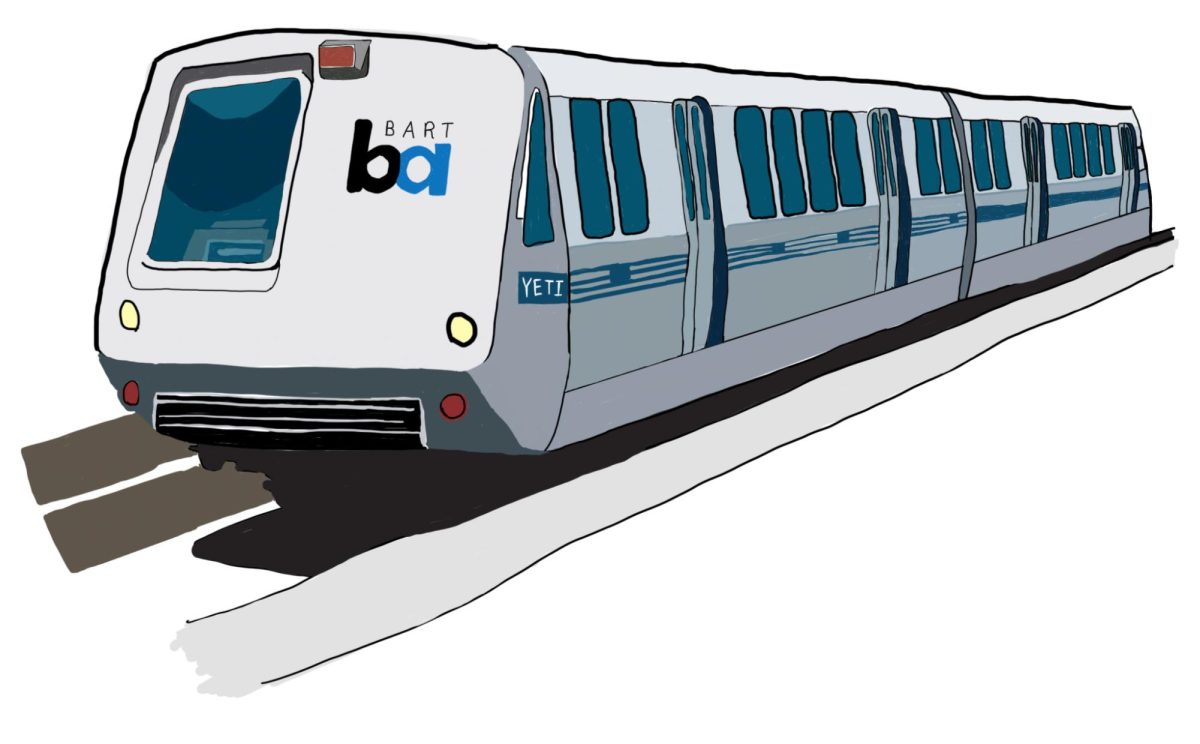
In January, the Bay Area Rapid Transit’s website stated that for the 2027 fiscal year, BART is facing a $376 million financial deficit, meaning its expenses exceed its revenue. The public transit agency is currently running on emergency funds that will run out in 2026.
The deficit is mostly due to BART’s ridership decline following the COVID-19 pandemic: In 2022, ridership rates were only about one-third of those in 2019. Additionally, about 1.2 million Bay Area residents worked from home in 2021, compared to 260,000 in 2019, according to the Bay Area Economic Council. This led to fewer commuters using BART to get to the office daily. Now, according to BART, the Bay Area has the highest work-from-home rates in the country.
Because BART’s funding model relies on fares to gain revenue, the ridership decline has heavily impacted the agency’s finances. More than 70% of BART’s revenue came from fares in 2019, compared to just 30% in 2025. “Our funding model no longer works for BART,” said Alicia Trost, Chief Communications Officer at BART, in an interview with The Urban Legend. “We’re serving half the trips, so half the money we used to get is no longer coming to BART.”
To combat the deficit, BART froze hiring for 56 positions in 2025 and 2026 and indefinitely deferred planned staffing increases. The agency also began running shorter trains to reduce energy costs and adjusted fares for inflation, among other measures.
“The very first step was to take every measure that we could immediately to make sure that we reduce the size of the deficit as much as we could without cutting transit service,” San Francisco Chief of Infrastructure, Climate and Mobility Alicia John-Baptiste said during the High School Press Forum at City Hall on Friday, May 1.
BART is also searching for alternative financial models to make up for the deficit. “We don’t want to cut service to a point that people aren’t going to ride BART, … so we need to find another source of revenue to make up that gap of people working remotely,” Trost said.
California Senate Bill 63, which will be on the Nov. 2026 ballot, could provide an additional source of revenue for BART. According to Digital Democracy, the bill is a 14-year measure that would raise sales taxes by 1% in San Francisco County and 0.5% in Alameda Contra Costa, San Mateo and Santa Clara counties.
If Californians vote to pass the bill, it would allocate the additional funds to various transit agencies in California, including BART, with the majority going towards preserving public transit services. In an April report, BART projected that for the next five years, the cost of the increased sales tax — in addition to other cost-saving measures — would solve most of the financial deficit.
If CA Senate Bill 63 does not pass, BART has created an alternative plan of service. Proposed measures include reducing train run times from every 15 to 20 minutes to every half hour, increasing fares by up to 30%, and closing stations such as South San Francisco and Oakland Airport. In the alternative plan, BART officials tentatively projected ridership to increase, though the agency noted that reducing service may decrease ridership.
“It’s like a death spiral,” said Landon Kan Huy ’26, a student at Lincoln High School and former member of the San Francisco Municipal Transportation Agency Youth Transportation Advisory Board. “BART has less money in its pockets, and less people want to take it. It just keeps going down, down and down, until eventually, … there’s just no BART.”
BART’s service reductions may have implications for students. According to Urban’s website, 8% of students live outside of San Francisco, some of whom regularly take BART. “I live in the East Bay. It’s a lot easier to take BART [to school], because traffic can be pretty bad in the morning and in the afternoon,” Kai Panilla ’28 said. Some students who live in San Francisco take BART as well.
Other Bay Area transportation systems, such as the San Francisco Municipal Railway (SFMUNI), are also experiencing financial deficits, which are forcing the agencies to reduce services. Loss of public transportation also touches on larger issues regarding equity, because it makes transportation less accessible to people in lower-income brackets.
“The transportation system is also a form of social justice,” said English teacher Vedita Cowaloosur. “It’s nice to have a system that is accessible to everybody, regardless of their income bracket or what sort of area they live in.”