


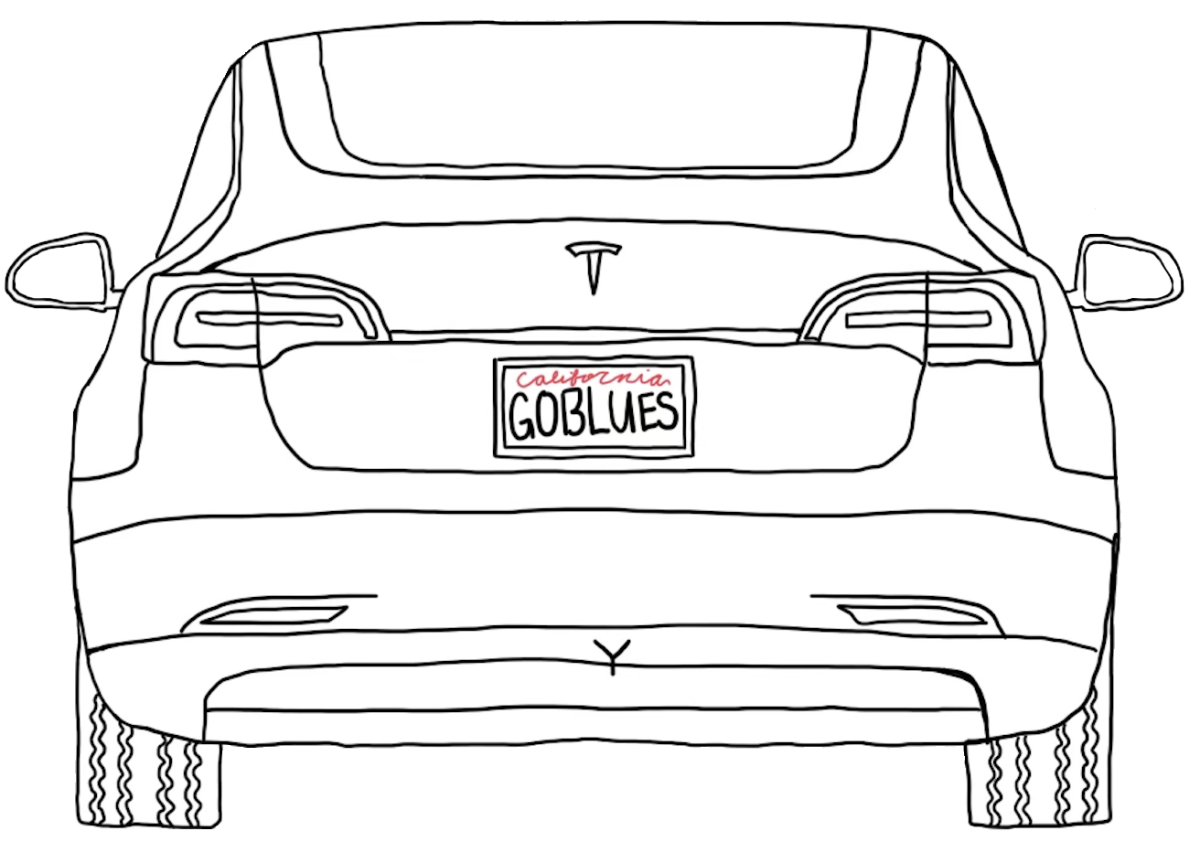
Since President Donald Trump appointed Elon Musk as head of the newly created Department of Government Efficiency (DOGE) on Nov. 12, 2024, protestors have launched anti-Tesla demonstrations across the United States and Europe.
Americans across the U.S. have protested Tesla to express their frustration with Musk’s growing influence in the federal government and his mass layoffs of federal employees. Drivers have adorned their Teslas with bumper stickers to distance themselves from Musk’s politics. Tesla sales have sharply decreased, causing the stock to plummet almost 40%, contrasting with the stock’s all-time high in December 2024.
In the past few months, DOGE has fired, suspended or driven out tens of thousands of government employees. “Musk is doing terrible things [in] our government,” Lawson Smith ’26 said. “Trump [is giving Musk] unprecedented power that isn’t being regulated very well.”
Although organizers of various anti-Tesla protests — often part of the Tesla Takedown campaign — stress the importance of their protests being nonviolent, protesters have burned Tesla Cybertrucks and thrown Molotov cocktails at Tesla dealerships in various West Coast locations. Musk and Trump both claim these attacks are coordinated. The FBI and the Bureau of Alcohol, Tobacco, Firearms and Explosives investigated the incidents and found no evidence to support those claims.
Ari Wayne ’27 reflected on the violence of these protests. “I don’t think there should be violence [at anti-Tesla protests],” she said. “Other [non-violent] activism is a much better way of expressing people’s emotions towards [Musk].”
Some students whose families own Teslas have mixed feelings about attending an anti-Tesla protest. “It’s so conflicting,” Wayne said. “I would consider going to an anti-Tesla protest, but I would feel guilty for doing it too, because I’m supporting this brand [by driving a Tesla].”
Others are willing to attend anti-Tesla protests while their families drive Teslas. “Because it’s not my car and it’s my parents’, I feel a little less conflicted because I don’t really choose what cars they buy,” Ella Pradhan ’27 said. “It’s more my choice to go to a protest.”
In addition to participating in protests, some Tesla owners have put bumper stickers on their Teslas. Simon Coyne Sutton ’28 said, “In Marin, [anti-Musk] bumper stickers are a big thing.” He emphasized how common it is for people to say they are against Tesla. “It’s … a community thing,” he said.
Some have specifically painted over their Cybertrucks with anti-Musk slogans. “I don’t see people vandalizing Tesla sedans or SUVs as much, but I definitely hear of people vandalizing their Cybertrucks to send a message to the company,” Coyne Sutton said.
Others think people should not equate Tesla with Musk’s actions. “The car someone drives every day to get from point A to point B shouldn’t be seen as some big political statement,” Max Woolf ’27 said.
Woolf believes disagreeing with the creators of big companies is unavoidable. “If you’re a conservative, and you went by that same logic, you couldn’t use Amazon, Microsoft, Facebook, Instagram and all these other technologies,” he said. “No matter where you put your money, it’s supporting something you probably don’t like.”
Debates around Musk’s government role have prompted some students to reflect on their values. Outside of Musk’s connection to the Trump administration, Tesla has made significant strides in producing electric cars and has laid the groundwork for future electric car manufacturers.
“In my opinion, it’s really important to keep introducing clean energy to society because of the climate crisis,” Pradhan said. “But the controversy forces you to think about which topic you care about more. ‘Do I care about clean energy, or do I care about all the things Musk stands for?’”